
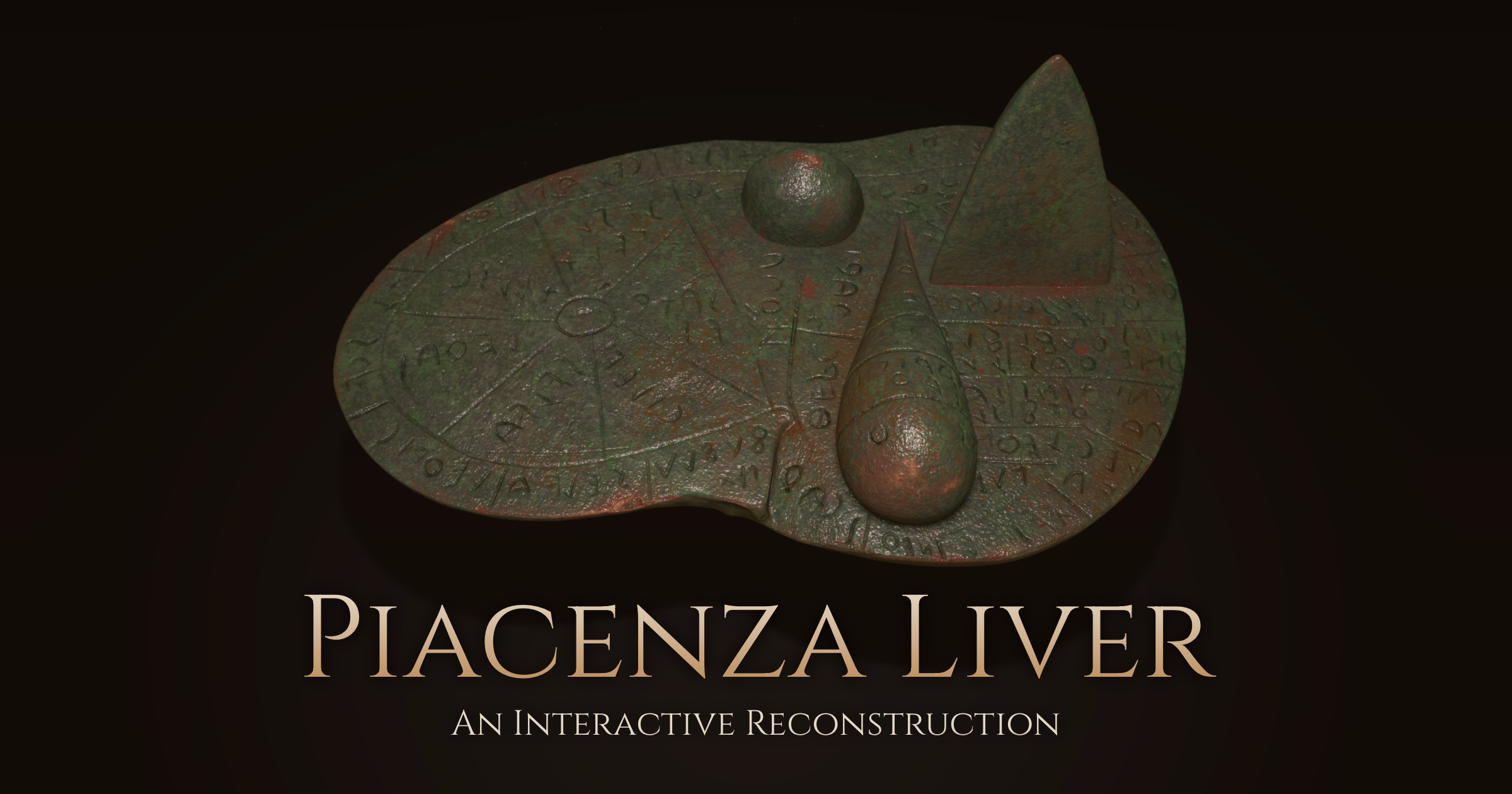
The Piacenza Liver (Fegato di Piacenza) is a small bronze model of a sheep’s liver, found near Piacenza in 1877 and kept today at the Musei Civici di Palazzo Farnese. For Etruscan priests it was a map of the divine: forty-two inscriptions name deities and regions of the cosmos, laid out on the organ the way a haruspex would have read a real liver.
Trying to study it online is frustrating. Good photographs of the original are scarce. Many of the reproductions that circulate are not faithful to the bronze, so it is easy to learn the wrong object. And the inscriptions themselves are barely explained on Wikipedia and similar pages, because the careful readings still live in specialist papers, many of them decades old and hard to reach.
Lorenzo Andraghetti, a Good AI Lab member who has followed Etruscan archaeology for years, built the resource he could not find: an open, bilingual reconstruction of the Liver that anyone can open in a browser, explore cell by cell, and cite. The code and the dataset are public. Click below to try it.
piacenzaliver.comExplore the interactive 3D Liver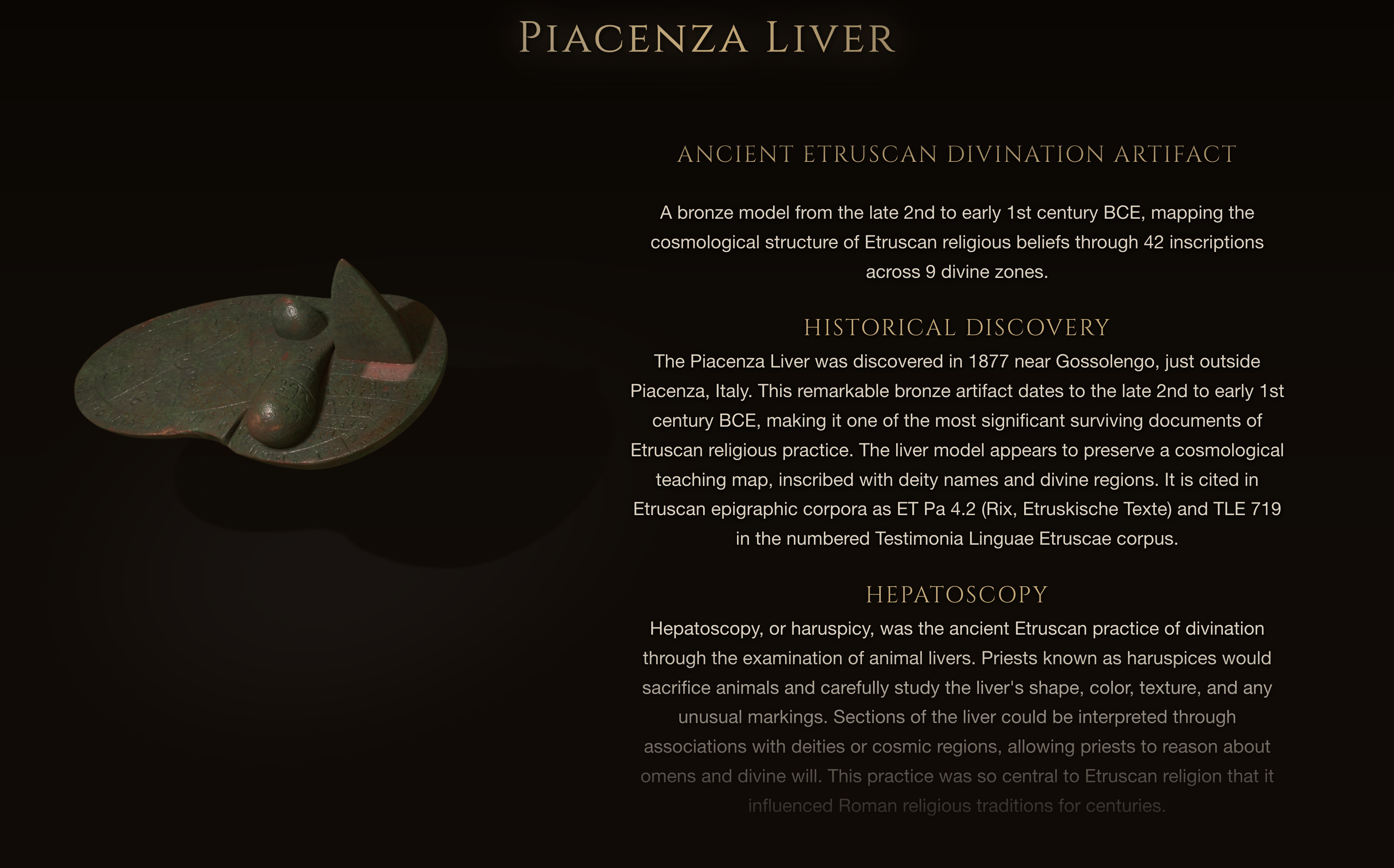
Starting from the sources
The project began with reading rather than modeling. Every one of the forty-two cells raises the same two questions: what is engraved there, and which deity does it name? Neither has a single tidy answer. Letters are worn, editors have proposed competing readings, and some names have no accepted identification at all.
So the first task was to reconstruct where scholarship actually stands, working through the literature that still anchors serious study of the bronze, from Maggiani and Colonna to van der Meer, Gottarelli, and Pernigotti. The result is recorded in the site itself: each deity has its own description, its Greek and Roman parallels, and the sources behind them, and the site’s About page sets out the editorial method.
None of this is offered as a final verdict. Where a reading is contested, the site says so instead of quietly picking a winner. And because everything sits in a public repository, disagreement is easy to act on: if you think an interpretation, a description, or a parallel is wrong, you can open an issue or a pull request and make the case.
From a prototype to a faithful model
The first working version was a prototype. Photographs stood in for the object, which was enough to test the core idea of selecting an inscription and attaching notes to it, but not enough to explore an artifact whose meaning is three-dimensional.
The system was then rebuilt around a proper 3D model: a liver you can turn, cells you can hover and select, camera views that focus on a single inscription, and a scholarly panel that follows what you click.
That step needed a model, and the museum was not able to provide one for the project. Luca Tampieri, a 3D artist, reconstructed one as close as possible to the bronze. Refined over several iterations, Tampieri’s model is what you see on the site today. It is not a scan of the artifact, but it is carefully made and visually very faithful to it.
Digitizations of the real object do exist, including the Fegato Etrusco model published on Sketchfab by Ispira, also mirrored on the museum account, and the museum’s own 3D Art XP experience. They are geometry, though, and nothing more: you can spin the object, but you cannot click a cell, read what is written in it, see which deity it names, or find out how secure that identification is. For anyone trying to actually study the Liver, an unannotated mesh answers none of the questions the artifact raises.
That is why the interpretive layer matters more than the model underneath it, and why a real scan would slot straight into this project. The hope is that one day an accurate scan of the bronze can carry these annotations, and that the museum that cares for the original finds the work useful for its own teaching and outreach.
What you can explore
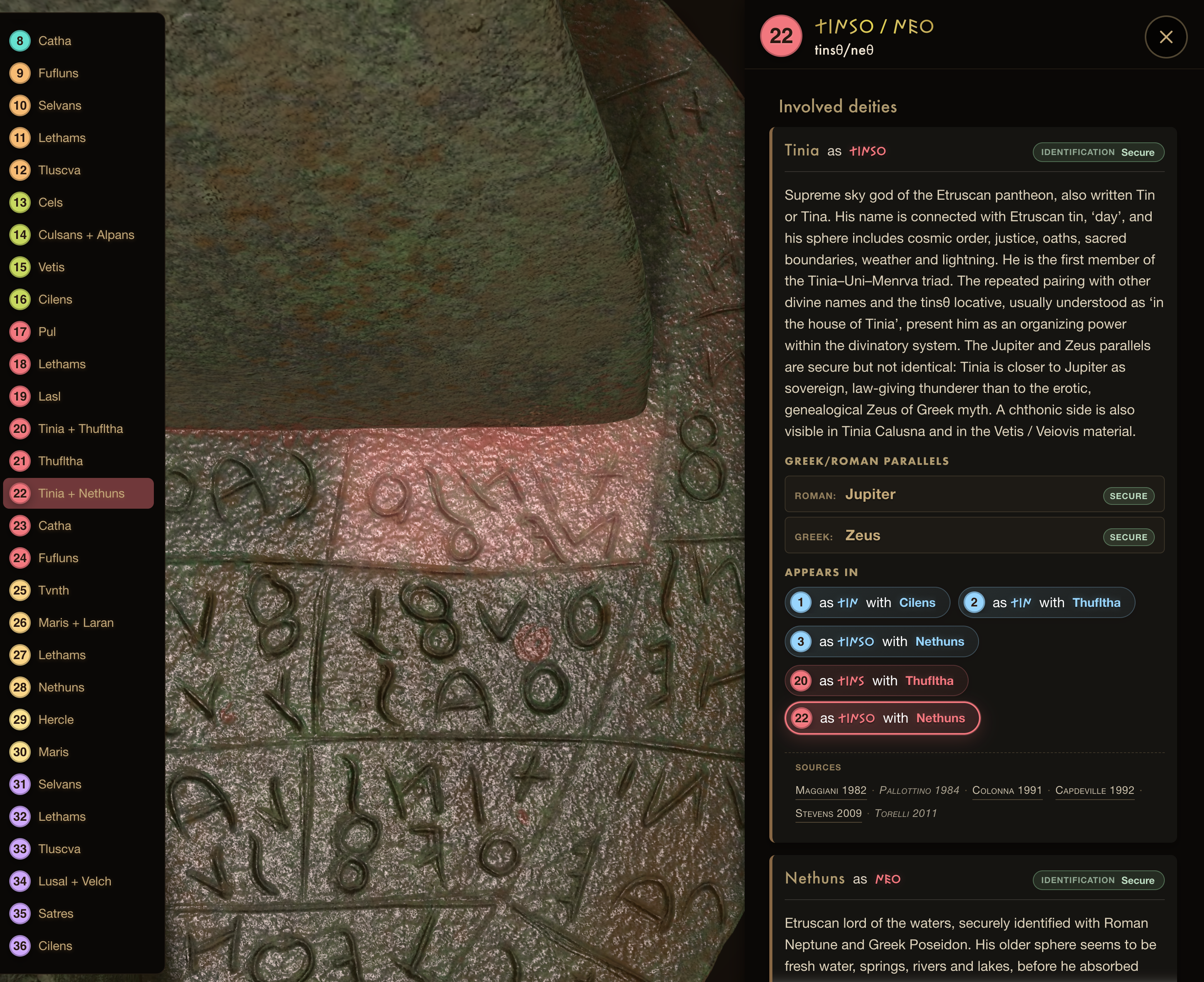
In the 3D view you can select any of the forty-two inscriptions and read the Etruscan text, its transliteration, and the deities it names. You can move through the Liver by cosmological region: Sky, Water, Earth, Underworld, Pars Familiaris, Pars Hostilis, and the anatomical reference zones.
Selecting a cell does more than zoom in. The cells face in every direction, and Etruscan runs from right to left, so a text you happen to be looking at from the wrong side is easy to misread or to read upside down. Each of the forty-two inscriptions therefore has its own viewpoint saved with it, and clicking one moves the camera there, presenting the letters upright and in the right reading direction.
Uncertainty is part of the interface. How legible an inscription is (legible, unclear, debated) is tracked separately from how secure its deity identification is (secure, probable, debated, unresolved), so a clear engraving with a contested meaning never looks like settled fact.
If you would rather skip the 3D viewer, the same material is available as a plain, fully navigable inscriptions page, where every cell, deity, and region can be browsed as a structured list with the same notes and sources. From that page you can also download the whole dataset in YAML and reuse the inscriptions, deities, zones, and editorial statuses in your own work.
How to use and contribute
The project is released to the public under an MIT license. Students can learn from it, researchers can cite individual cells and deities with stable links, and educators can put it next to the bronze or next to a textbook plate. The work as a whole can be cited as:
Andraghetti, L. (2026). The Piacenza Liver: an interactive scholarly visualization. https://piacenzaliver.com/
- Site: piacenzaliver.com
- Inscriptions and dataset: piacenzaliver.com/en/inscriptions
Three kinds of help are especially welcome. New languages, since the interface is only English and Italian today. Improvements to the code, from accessibility to mobile behavior. And, most of all, corrections to the scholarly content: readings, deity interpretations, descriptions, parallels, and bibliography. Open an issue or a pull request and it will be read.
3D reconstruction by Luca Tampieri. Research, development, and site by Lorenzo Andraghetti.