



A Needle in a Haystack
A single recommendation written by an NGO somewhere in the world might seem like a meaningful, yet isolated contribution. Maybe it’s part of a report about access to education. Maybe it calls for stronger protections for children. Or perhaps it highlights an issue affecting a vulnerable community.
But sometimes that recommendation travels much further than expected, connecting with similar recommendations from other parties that have identified the same issues or advocated for the same beneficiaries from a different viewpoint. It might appear in discussions between governments or show up in international reviews. It might even reach the level of formal international commitments: ones that governments are expected to act on and that are tracked across years and review cycles.
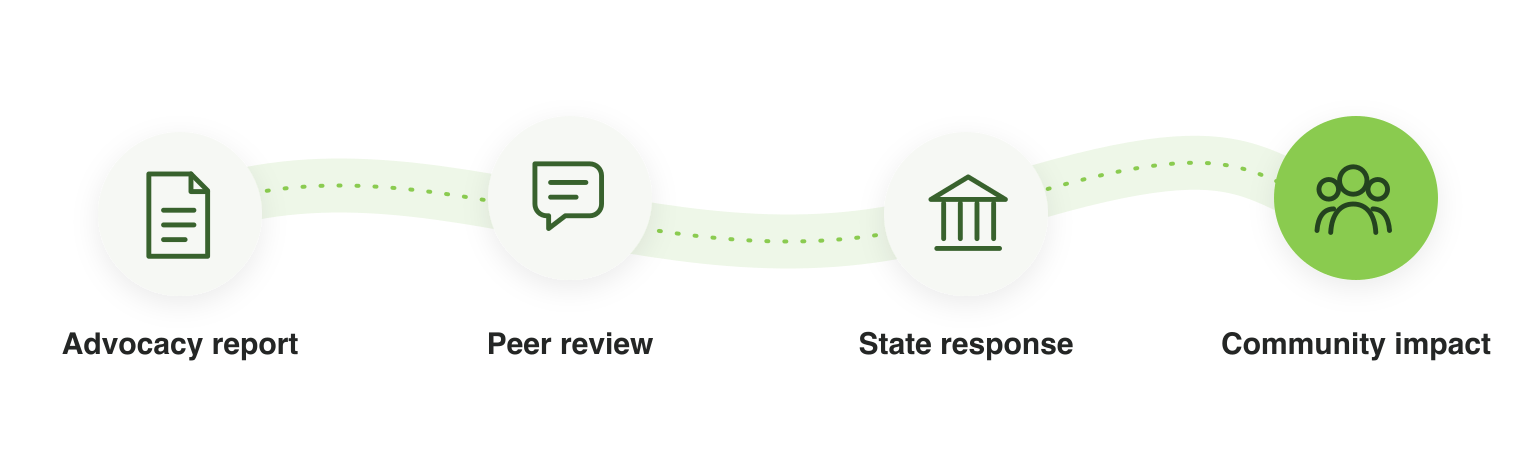
For organizations working in advocacy and humanitarian efforts, this possibility is what makes the work so meaningful. But how do they know when a recommendation actually made that journey? How can they assess if a recommendation actually made a difference? Tracking that journey, from advocacy to international policy, is surprisingly difficult. It entails looking through thousands of recommendations in hundreds of long reports. But it doesn't necessarily have to be.
The Surprisingly Hard Job of Connecting the Dots
At first glance, this task might seem straightforward. If an organization recommends improving access to education, and a similar recommendation from another organization appears, that seems like a clear connection. In practice, it’s rarely that simple. Recommendations written by different institutions often use different language. They might focus on different aspects of the same issue, provide varying levels of detail, or target different stages of the policy and legislative process.
As a result, identifying connections between recommendations usually requires people to read through long lists of documents and interpret whether two statements are truly aligned. This process is inherently subjective. Experts must make judgment calls about how similar two recommendations are, which aspects matter most, and where to draw the line between “related” and “different.” Even small differences in wording or emphasis can lead to different interpretations. Because of this subjectivity, the results are nearly impossible to reproduce. Two people reviewing the same set of recommendations may arrive at different conclusions, and even the same person might classify them differently at another time, depending on context, focus, or evolving understanding of the material.
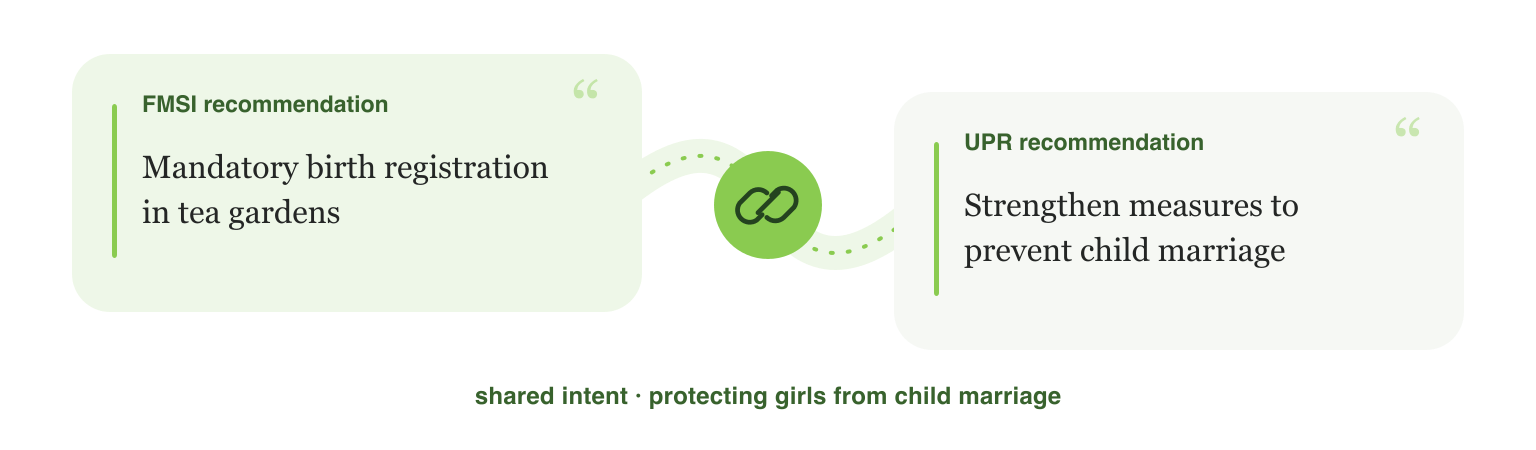
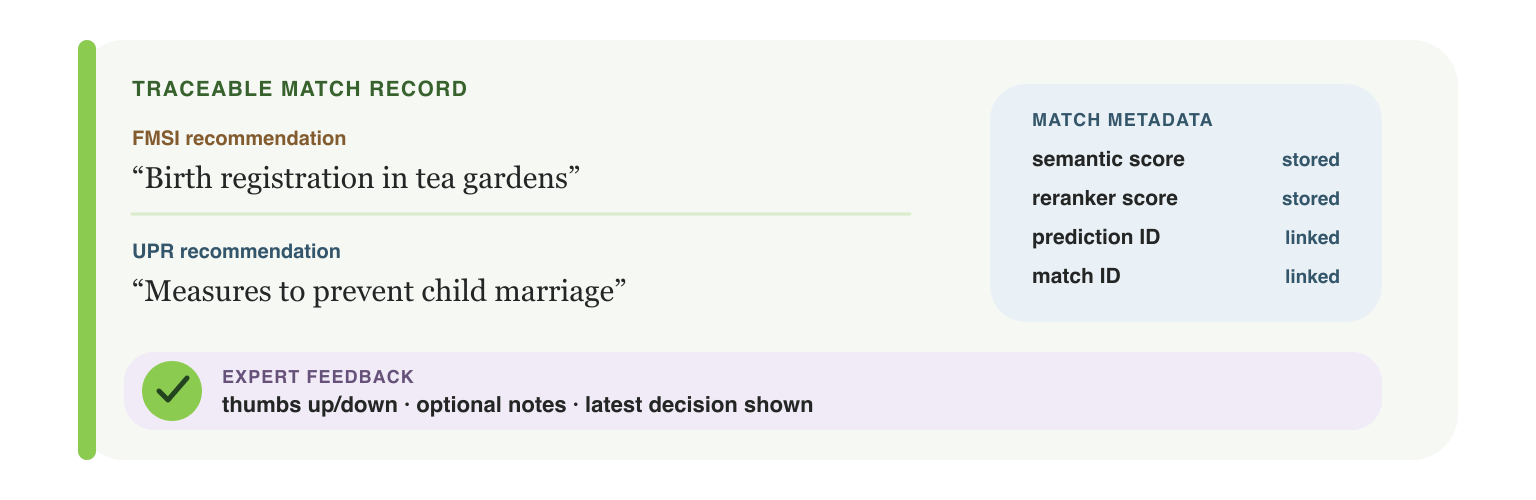
The project team encountered both sides of this problem. Recommendations about disability legislation and implementation can share vocabulary while asking for materially different policy actions. Conversely, mandatory birth registration in tea gardens and broader measures to prevent child marriage can use different language while pursuing the same underlying outcome.
This lack of consistency not only affects reliability and traceability, but also compounds the challenge at scale. For organizations working across many countries and review processes, this can quickly become a major task.
It involves:
- Reading and comparing large numbers of recommendations
- Interpreting how closely they align
- Tracking connections across reports, institutions, and review cycles
As the number of documents grows, so does the workload. What starts as an important analytical process can easily turn into weeks of manual document comparison.
The UPR and FMSI’s Advocacy Work
The Universal Periodic Review (UPR), run by the United Nations (UN), is a unique process that involves a periodic review of the human rights records of all 193 UN Member States.
During each review cycle:
- Governments report on their human rights progress
- Other countries provide recommendations for improvement
- Civil society organizations submit reports highlighting important issues
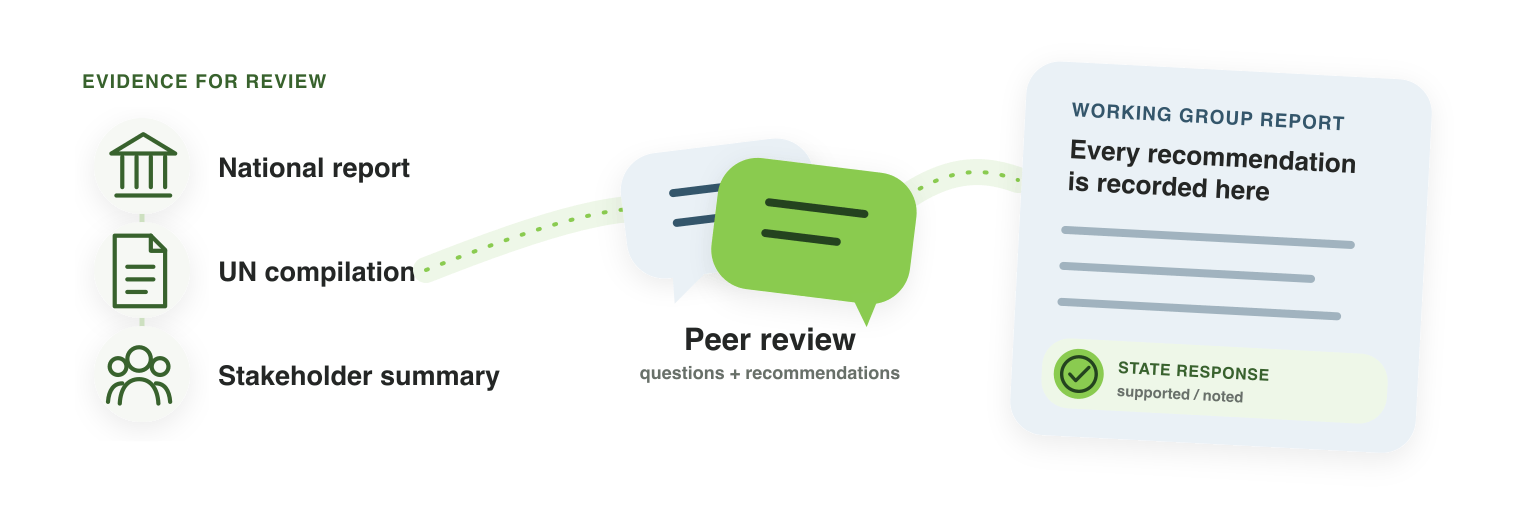
The review is informed by three public documents: a national report from the State under review, a compilation of relevant UN information prepared by the Office of the High Commissioner for Human Rights (OHCHR), and an OHCHR summary of stakeholder submissions. During the peer review, other States ask questions and make recommendations. The resulting Working Group report records those recommendations, and the reviewed State indicates whether each one is supported or noted (OHCHR guidance).
For organizations working within advocacy, the UPR is an important opportunity. It creates a space where civil society voices can draw international attention and encourage governments to commit to change. Organizations such as Fondazione Marista per la Solidarietà Internazionale (FMSI) actively participate in this process, contributing recommendations and reports that focus on the protection and well-being of children and vulnerable communities.
But contributing recommendations is only the beginning. To truly understand the impact of their work, organizations also need to see how their recommendations connect to those that appear in the UPR process itself.
The Coordination Challenge
The scale of the UPR process makes coordination inherently complex. On average, more than 30 stakeholder submissions are received per country, reflecting contributions from civil society organizations, national human rights institutions, UN entities, regional organizations, and other stakeholders. These submissions are then complemented by a much larger number of recommendations made by Member States and Observers during the review itself. In the last completed cycle (2017–2022), the 193 States under review received 43,229 such recommendations in total, averaging roughly 224 per country (OHCHR — Third cycle) — and in the current fourth cycle (2022–2027) that volume is climbing further still, up around 20% for the States reviewed so far (UPR Facts and Figures).
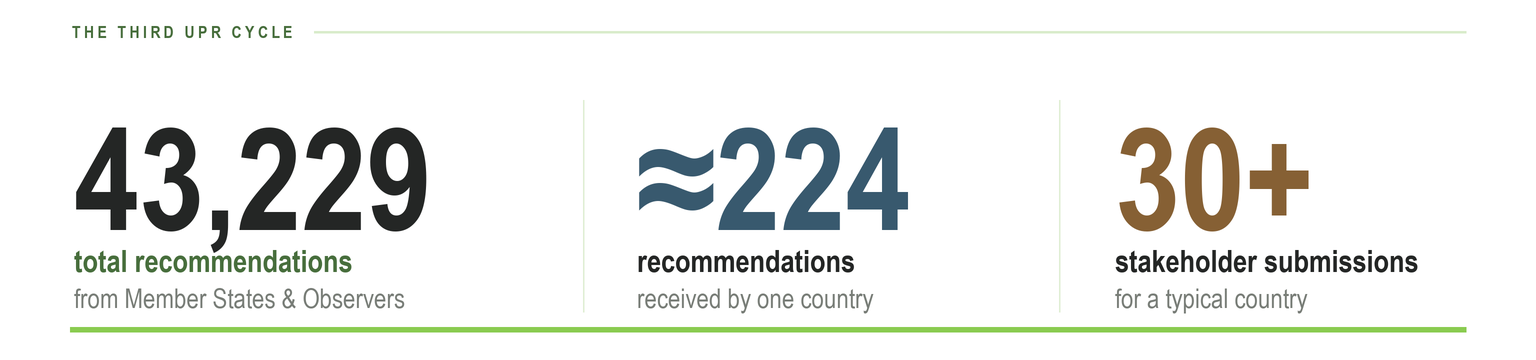
Taken together, this means that for every country, dozens of reports and hundreds of recommendations must be reviewed, compared, and interpreted. Each recommendation may overlap partially with others, use different terminology, or address the same issue from different angles. For organizations trying to track how their work fits into this landscape, the challenge is not just volume; it is coordination. They must identify where their priorities appear in the final recommendations, understand how different actors frame similar issues, and follow how these connections evolve across review cycles.
As the number of submissions and recommendations continues to grow, so does the difficulty of maintaining a clear, consistent overview. What should be a strategic exercise in identifying alignment and influence quickly becomes a fragmented and time-intensive process.
Addressing this coordination challenge requires more than manual comparison; it calls for a systematic way to make sense of large volumes of unstructured text. The core goal of this project is to automatically identify and surface meaningful matches between FMSI and UPR recommendations by transforming unstructured documents into comparable signals and applying semantic matching, while maintaining transparency in how connections are made and preserving user control over the final interpretation.
UPR Matcher: A New Way to Explore Connections
To help make this work easier, the Good AI Lab (GAL) partnered with FMSI to develop the UPR Matcher. The goal of this collaboration was simple: make it easier to identify meaningful connections between recommendations from civil society organizations and other stakeholders and those that appear in the UPR process.
Instead of requiring reviewers to manually search through hundreds of recommendations, the tool helps highlight where possible overlaps exist. Think of it as surfacing connections that semantic complexity and data volume would otherwise keep hidden.
At a high level, UPR Matcher reads the two sets of recommendations, looks for meaning rather than identical wording, and presents a focused set of likely connections for expert review. The implementation combines document extraction and semantic matching, but the experience for the reviewer is intentionally simple: the system narrows the search while people retain control of the interpretation. The full implementation is available in the project’s open-source repository.
Under the hood, the tool first surfaces a broad set of possible connections and then takes a closer look at the most plausible pairs. This two-stage approach reduces the volume of material experts need to inspect without hiding the recommendations or the reason they were brought together (matching and re-ranking code).
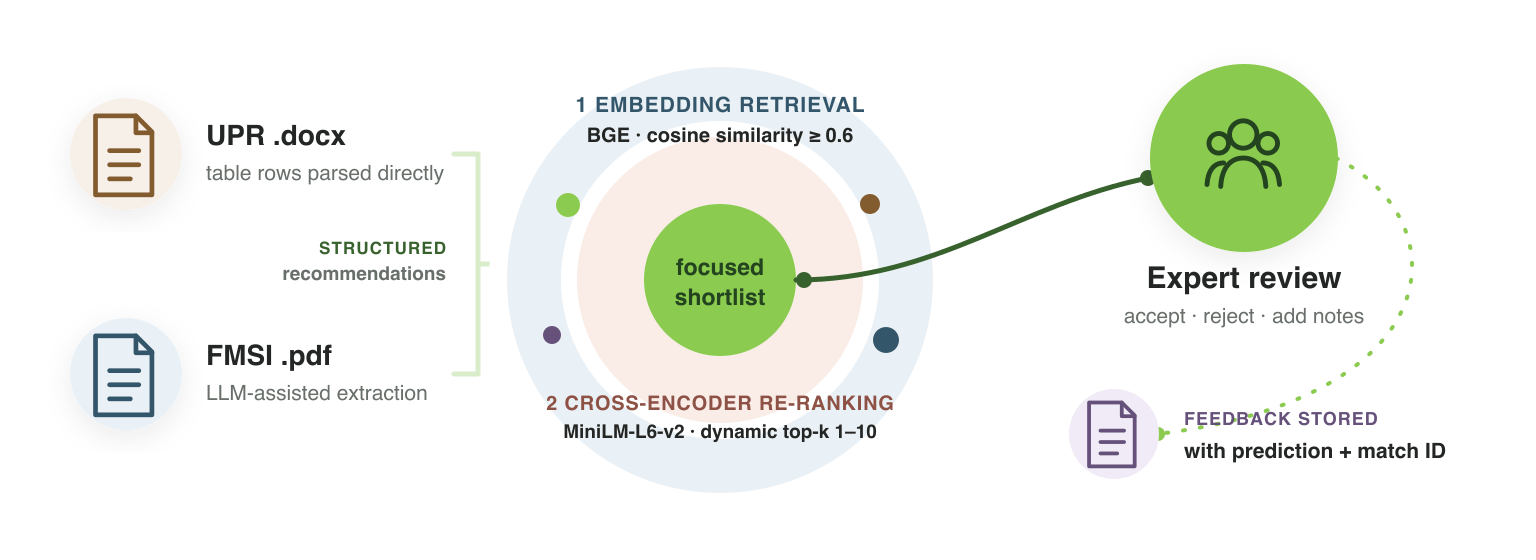
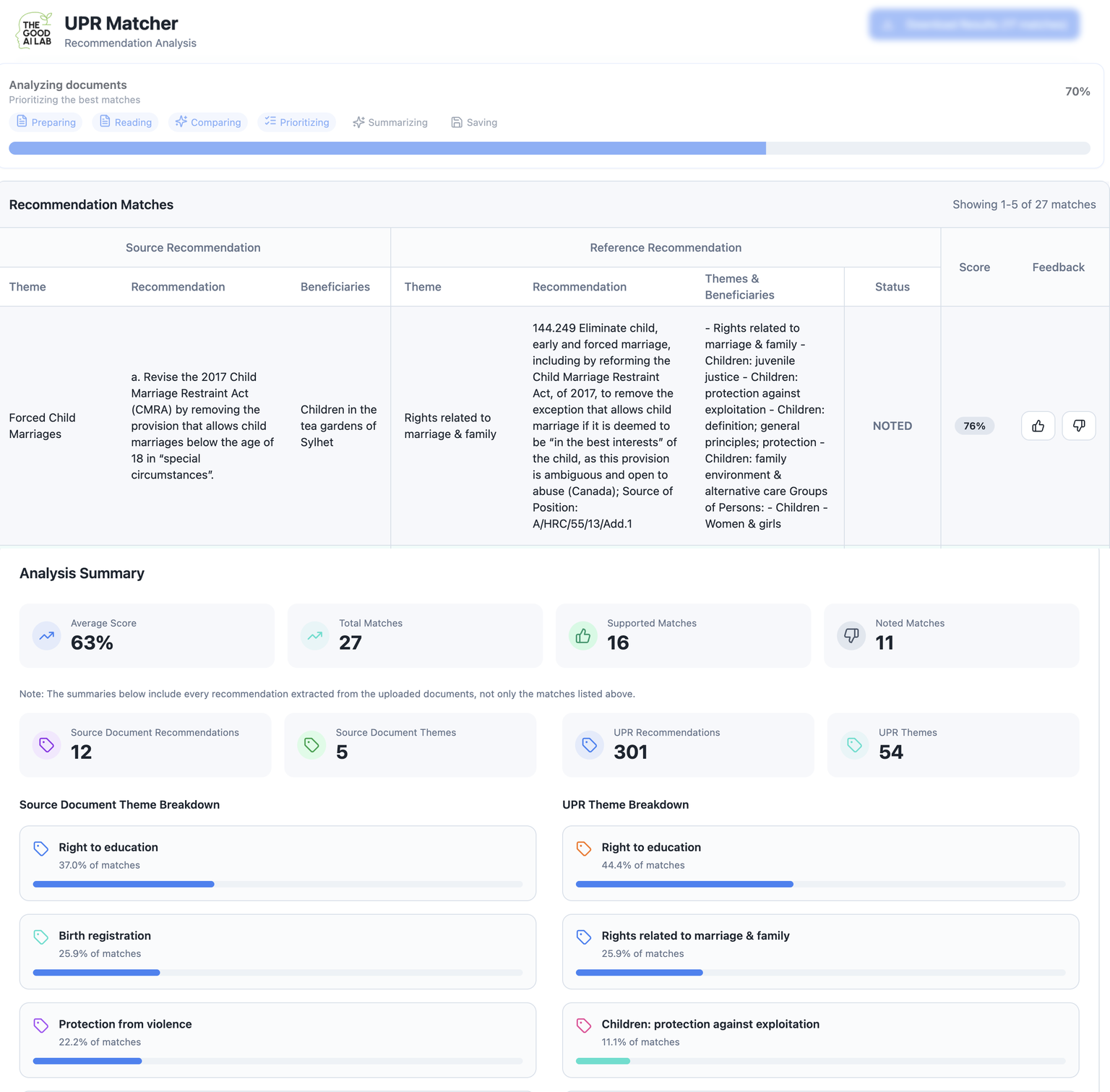
Human experts then review these suggestions and confirm which ones truly match. Their feedback is recorded against each candidate, creating a traceable review history. This allows teams to spend less time searching through documents and more time focusing on what the results mean.
Understanding the context behind a recommendation (how it relates to a country’s policies, political environment, or social challenges) requires experience and careful analysis. Hence, the UPR Matcher is not designed to replace human judgment but rather to augment it with data-driven insights. Expert interpretation remains essential.
What technology can do is assist with the heavy lifting: scanning large volumes of text, identifying patterns, and surfacing connections that might otherwise take hours to find. This allows experts to focus on the most relevant, high-confidence matches, without spending time reviewing low-confidence candidates. In doing so, they can apply their domain knowledge to interpret results, resolve ambiguities, and make informed decisions where it matters most.
Turning Advocacy Into Real-World Change
Non-profits and civil society organizations invest enormous effort into gathering evidence, producing reports, and making recommendations that aim to improve policies and protect communities. Their work contributes to global conversations about human rights, education, social protection, and justice. Yet translating this effort into visible, measurable impact remains a challenge.
When organizations can easily see how their recommendations connect to global policy discussions, new possibilities emerge. They can better understand whether the issues they raise are being echoed in international reviews. They can track how advocacy priorities evolve across different UPR cycles. And they can demonstrate their impact more clearly, to partners, supporters, and the communities they serve. In this way, connecting recommendations across processes helps bridge the gap between advocacy and real-world outcomes, turning sustained effort into tangible progress.
The resulting workflow significantly reduces the manual effort required to align organizational recommendations with those emerging from the UPR process, making it easier to generate consistent, traceable insights at scale.
Key benefits include:
- Faster and more manageable review cycles
- More consistent and transparent matching decisions
- Clear traceability of how connections are identified
- The ability to work effectively across large document sets
- Flexibility to balance precision and coverage based on analytical needs
The goal is not automation for its own sake, but to improve clarity, efficiency, and consistency in analysis of advocacy efforts. By combining large language model capabilities with principled NLP techniques, this approach demonstrates how hybrid AI systems can responsibly support complex analytical workflows. At the Good AI Lab, we believe the most impactful AI systems are not those that replace human expertise, but those that strengthen it.
When Small Ideas Lead to Big Change
A single recommendation may start as just a few lines in a report. But when that recommendation appears in international reviews, shapes discussions between governments, and contributes to policy commitments, it becomes part of something much larger.
Understanding that journey, from advocacy to global policy, is essential for organizations working to improve the lives of those in need around the world. Tools like the GAL UPR Matcher attempt to illuminate parts of that path. Because sometimes the most powerful impact isn’t just in writing recommendations. It’s in seeing how those recommendations ripple outward, across institutions, across borders, and ultimately into real change for the communities they were written to protect.
If you'd like to explore the methodology or build on this work, the UPR Matcher is open source. A full technical report is on its way. Stay tuned for more.
The-Good-AI-Lab/upr-matcherExplore the open-source UPR Matcher on GitHubStar on GitHub